March 2026 · ForensicMark Blog
Forensic watermarking: leak detection and DMCA takedowns
When a confidential image leaks, forensic watermarking tells you exactly which recipient's copy it is. Here's how per-recipient watermarking works — and how to convert that evidence into a DMCA takedown.
The leak problem: a leaked image with no obvious culprit
You distribute a confidential product render, a pre-publication photograph, or an unreleased design asset to a group of recipients — contractors, press contacts, licensing partners, or internal stakeholders. Days later, the image appears on a competitor's website, a leak forum, or a social media account without your authorization. You have a leak. But you shared the image with fifty people. Who did it?
Without forensic watermarking, the answer is almost always "we don't know." You can audit email logs, run an internal investigation, and ask pointed questions — but you have no technical evidence linking any specific recipient to the leaked copy. With forensic watermarking, the leaked image carries the answer inside its pixels.
What forensic watermarking is
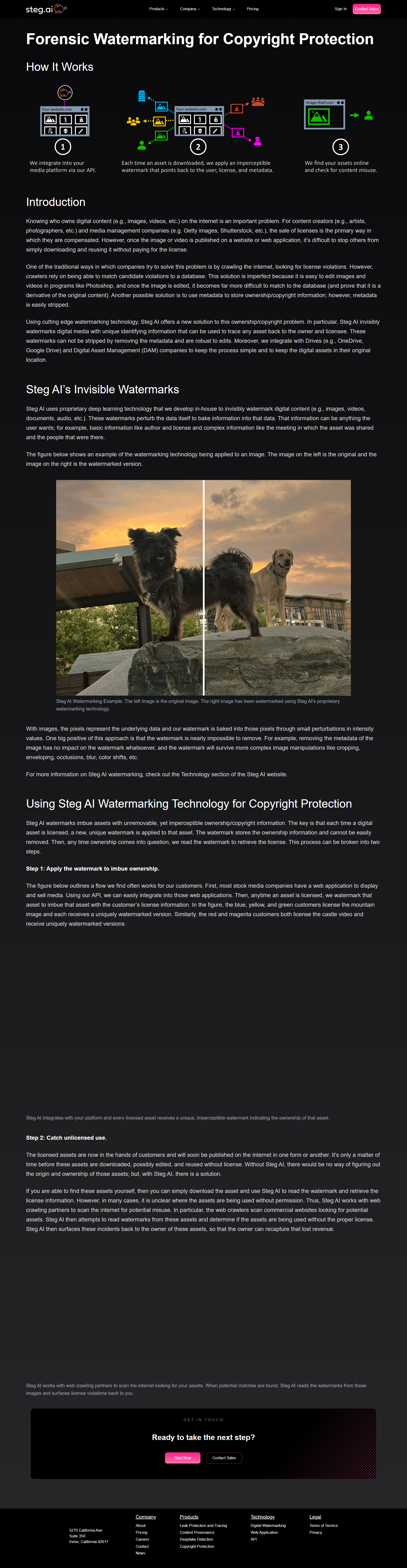
Forensic watermarking solves the attribution problem by encoding a unique, imperceptible payload into each copy of an image before delivery. Every recipient receives a visually identical image, but each copy carries a different embedded identifier — a recipient ID, access token, distribution code, or any value that maps back to a specific person in your records.
When the image surfaces without authorization, you run the found copy through the ForensicMark detection API. The decoder extracts the payload and returns the identifier embedded in that copy. You have gone from "we have a leak" to "we know exactly which copy leaked — and therefore which recipient or distribution channel is the source."
Forensic watermarking is different from visible watermarking (a logo or text overlay burned into the image). A visible watermark is a deterrent: viewers can see it and know the image is owned. It can be cropped out or removed with AI inpainting. A forensic watermark is imperceptible — the recipient cannot see it, cannot know whether it exists, and cannot remove it without visibly degrading the image. Its purpose is forensic evidence, not deterrence. See the full comparison in our guide to invisible watermarking.
Step 1: embed a unique watermark per recipient
Integrate the ForensicMark embed API into your distribution workflow. When preparing each copy for a specific recipient, POST the image and the recipient's unique identifier:
// Embed unique forensic watermark per recipient
POST /embed
{
  "image": "<base64 or URL>",
  "payload": "recipient_id:1234"
}

// Response: watermarked image, visually identical to the original
The API returns a watermarked image perceptually indistinguishable from the original. Deliver this copy — not the master — to recipient 1234. Repeat for each recipient with their respective identifier. ForensicMark's payload capacity supports up to 48 bits, sufficient for over 281 trillion unique identifiers.
Store the mapping of payload values to recipient records in your own database. ForensicMark stores no data about your recipients or your distribution list. The payload is yours; the decoding key is yours.
You can also embed watermarks interactively using the ForensicMark embed tool — no API integration required for lower-volume workflows.
Step 2: detect the watermark in the leaked image
When you find the unauthorized copy — on a website, in a news article, in a social media post — download it and submit it to the detection API:
// Detect forensic watermark from leaked image
POST /detect
{
  "image": "<base64 or URL>"
}

// Response:
{
  "detected": true,
  "payload": "recipient_id:1234",
  "confidence": 0.98
}
The decoder returns the embedded payload and a confidence score. A high-confidence result is strong technical evidence that this specific copy originated from the delivery to recipient 1234 — even if the image has been JPEG-compressed, cropped, screenshotted, or re-uploaded through social media since it leaked.
Try the detection flow yourself with the ForensicMark detection tool. Upload any watermarked image and verify that the payload is correctly recovered.
Step 3: build your evidence package
Before filing a takedown, document what you have:
- The URL where the unauthorized copy was found, with a timestamp.
- A downloaded copy of the infringing image.
- The detection API response — showing the payload recovered, the confidence score, and the API call timestamp.
- Your internal record mapping that payload value to the specific recipient.
- Your copyright registration or registration application, if you have one (not required for DMCA, but strengthens the claim).
The detection result proves that the infringing image contains a payload you embedded — establishing that the image originated from your systems and is your copyrighted work. This is the technical evidence layer that distinguishes your takedown from an unsubstantiated claim.

ForensicMark is partnered with CopyrightShark for automated DMCA enforcement
CopyrightShark monitors the web for unauthorized copies of your watermarked images, matches detections against your distribution log, and files DMCA takedown notices automatically. You get a detection hit, a takedown filing, and a removal confirmation — without handling any of it manually. The watermark is the evidence; CopyrightShark is the enforcement layer.
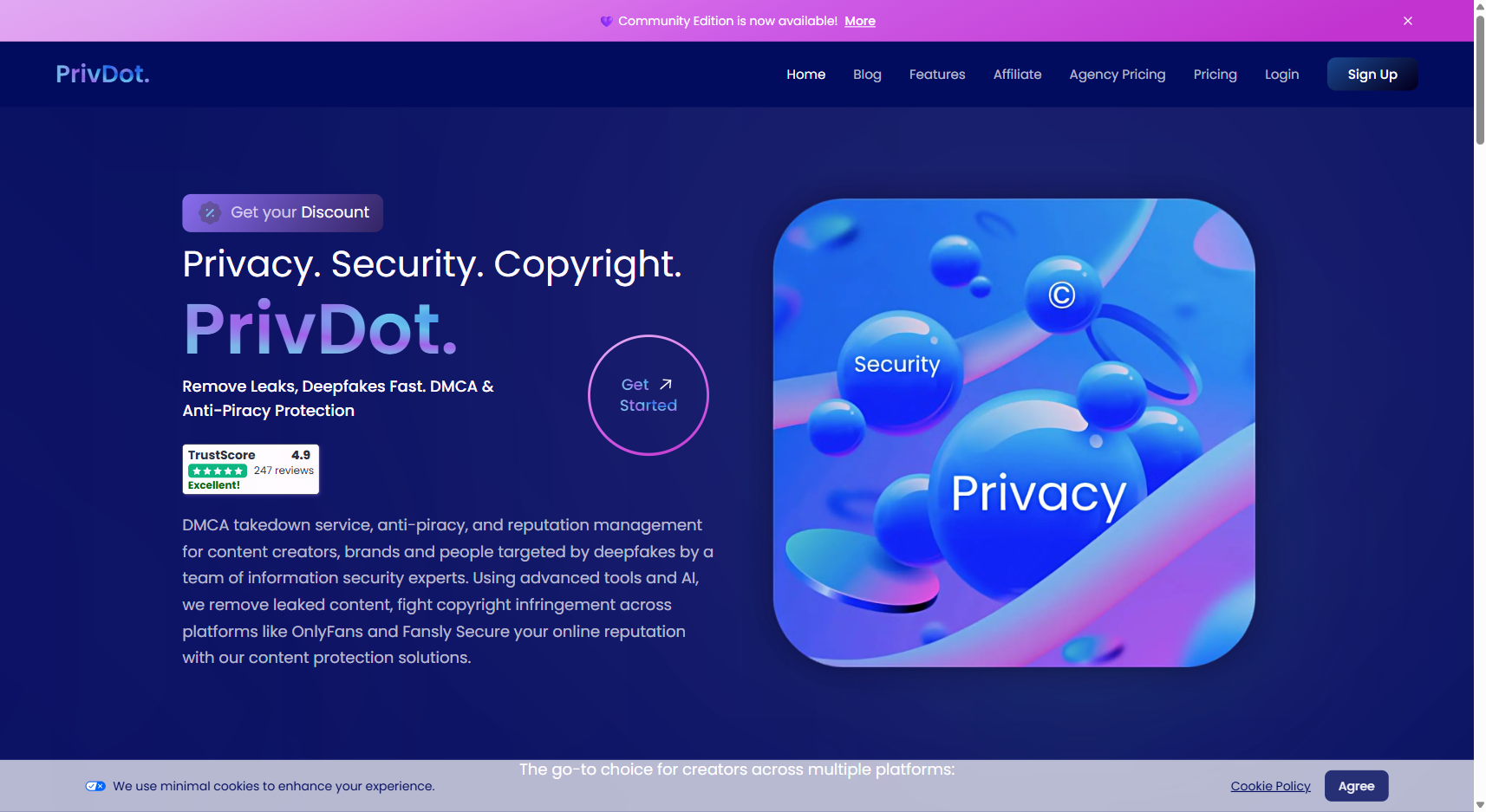
If your leaked image has also been used in a deepfake, posted to adult platforms, or is circulating on sites that are slow to respond to standard DMCA notices, PrivDot is worth knowing about. PrivDot is a privacy and anti-piracy protection service built specifically for creators, with a 4.9 TrustScore from over 247 reviews and a client base of 1,500+ creators. They handle the full removal workflow — DMCA takedown filing, deepfake and non-consensual content removal, dark web monitoring, and privacy protection — so you don't have to navigate each platform's abuse process manually. Paired with the forensic detection report from ForensicMark, PrivDot's team has the technical evidence they need to file targeted, well-documented takedowns on your behalf.
Step 4: file a DMCA takedown backed by technical evidence
A DMCA Section 512(c) takedown notice requires: identification of the copyrighted work, identification of the infringing material and its location, a statement of good faith belief that the use is unauthorized, your contact information, and a declaration under penalty of perjury. The watermark detection report satisfies the technical identification element — it ties the infringing copy to your original.
For hosting platforms, social networks, and search engines, the process is:
- Submit the takedown notice to the platform's designated DMCA agent (required by law to be publicly listed).
- Include the URL of the infringing content and the URL of your original (or a description of it).
- Attach or cite the detection report as supporting documentation.
- Most major platforms — Google, Meta, X, Cloudflare — respond within 24–72 hours for well-documented notices.
If the leak also implicates a specific recipient in a legal or contractual breach, the watermark evidence can support civil proceedings — it is a technical record, not just a policy notice.
What happens when the leaked image is cropped or edited
Neural forensic watermarks are trained to survive common real-world transformations. The watermark persists reliably through JPEG re-encoding at typical quality settings (60–85%), moderate cropping (up to approximately 50% of the image area), resizing, rotation, brightness and contrast adjustments, and social media transcoding (Instagram, X, WhatsApp all transcode uploaded images and do not strip neural watermarks).
For images that have been aggressively cropped to a small fragment or significantly altered with stylization or AI tools, detection may return a lower confidence score or may not recover the payload at all. In those cases the watermark evidence is inconclusive. The system does not produce high-confidence false positives under transformation: if confidence is low, you have insufficient evidence; if confidence is high, the payload is correct.
Forensic watermarking vs. DRM and access controls
DRM (digital rights management) and access controls prevent unauthorized access at the point of distribution — they are gatekeeping technologies. Forensic watermarking is a forensic technology: it does not prevent a recipient from copying or sharing the image, but it records who did so in the image itself.
The two approaches are complementary. Access controls reduce the risk of leaks; forensic watermarking provides attribution when a leak happens anyway. For high-value assets distributed to large recipient groups — press embargoes, pre-release content, licensed image libraries — the combination of access control and per-recipient forensic watermarks gives you both prevention and accountability.

Forensic watermarking and C2PA: complementary layers
C2PA content credentials attach a cryptographically signed manifest to the file that records provenance — who created it, when, and with what tools. C2PA provides verifiable, tamper-evident provenance when the manifest is intact. However, C2PA manifests are stored in file metadata and are stripped by screenshots and most social media platforms.
Forensic watermarks live inside the pixels and survive metadata stripping. When you need to track an image through social media distribution or identify which copy of many was leaked, the pixel-level watermark is the only evidence layer that persists. C2PA and forensic watermarking address different threat models; for assets that need to survive real-world distribution, you want both. See our guide on EU AI Act watermarking compliance for more on how these layers interact.
Practical implementation checklist
- Watermark at delivery time, not in batch ahead of time. Generate per-recipient copies when each delivery is made, not in advance. This prevents the master from being accidentally distributed.
- Never distribute the same watermarked copy to multiple recipients. The whole point is uniqueness per recipient. A common mistake is watermarking once and sending the same copy to everyone.
- Store your payload-to-recipient map securely. The forensic value of the watermark depends entirely on this mapping. Treat it as a security record.
- Keep the unwatermarked master separate. The master should never leave your systems. Only watermarked copies go to recipients.
- Test detection before relying on it. Before deploying a forensic watermarking workflow for high-value assets, verify end-to-end: embed a payload, run the image through typical transformations (JPEG save, screenshot, resize), and confirm the detector recovers the payload with high confidence.
- Log every delivery. Record which payload was embedded in which copy, delivered to which recipient, at what time. This log is your chain of custody document.
Frequently asked questions about forensic watermarking
What is forensic watermarking?
Forensic watermarking embeds an imperceptible, unique identifier into each copy of an image before distribution. When an unauthorized copy surfaces, the embedded payload identifies which recipient's copy leaked — providing technical evidence of the leak source without altering the visible appearance of the image.
Does forensic watermarking survive JPEG compression and screenshots?
Yes. Neural forensic watermarks are trained to survive JPEG re-encoding at typical quality settings (60–85%), moderate cropping (up to ~50% of image area), resizing, rotation, and screenshots taken on phone or desktop screens. Social media platforms that transcode uploaded images — Instagram, X (Twitter), WhatsApp — generally do not destroy the watermark.
How does forensic watermarking support DMCA takedowns?
The watermark detection result — showing your embedded payload recovered from the infringing image — demonstrates that the image originated from your systems. This evidence can be cited in the takedown notice or provided as supporting documentation to hosting platforms. It distinguishes your claim from an unsubstantiated assertion of ownership.
Can forensic watermarking produce a false positive?
No. When aggressive transformations degrade the watermark, the decoder returns a low confidence score or fails to recover a payload. It does not produce a high-confidence result pointing to the wrong recipient. A high-confidence result means the payload is correct.
What is the difference between forensic and visible watermarking?
Visible watermarks (logos, text overlays) are deterrents — they can be seen and can be removed by cropping or AI inpainting. Forensic watermarks are imperceptible. Viewers cannot see them and cannot know whether an image is watermarked. Their value is post-hoc: you find a leaked image and decode the payload to identify the source.
How many unique recipients does ForensicMark support?
ForensicMark's payload supports up to 48 bits — over 281 trillion unique identifiers. Sufficient for any realistic distribution scenario.